
When a Brand Designer Took on Direct Response

My Role Lead Designer • Direct Response Strategy • Landing Page Architecture
Project Breakdown:
Overview
Why These “Ugly” Landing Pages Worked
DIRECT RESPONSE
LANDING PAGE DESIGN
CONVERSION OPTIMIZATION
UX STRATEGY
DESIGN SYSTEMS
A/B TESTING
PERFORMANCE MARKETING
CUSTOMER ACQUISITION
When I joined Smashtech in 2018, direct response marketing was a completely different world from anything I had worked on before. My background was in eCommerce and brand design. I cared about polished experiences, strong visual systems, and cohesive customer journeys.
Then I saw SkinnyFit’s acquisition landers.
Honestly, I thought they were ugly.
They felt cluttered. Aggressive. A little gimmicky. Everything my design instincts wanted to avoid. But they worked. For years, those pages helped drive customer acquisition and fuel the company’s growth.
Over time, I learned they weren’t trying to be beautiful. They were built to persuade, educate, and convert. By 2023, however, performance had started to slow. Customer expectations had changed. It was time to rethink a system that had remained largely unchanged for years.
The Challenge
The challenge wasn't simply redesigning a landing page.
These landers had been generating customers for years. They were built on proven conversion principles that couldn't be ignored. The goal was to modernize the experience without losing what made it successful.
Any new design needed to balance UX, storytelling, and conversion. It also needed to scale. What started as a redesign for SkinnyFit's top-selling Super Youth Tropical Punch product became a scalable framework that could be adapted across 15 products in the portfolio.
The Approach
Every Section Had a Purpose
When I first looked at SkinnyFit’s acquisition landers, my instinct was to simplify them. Remove sections. Clean things up. Make them feel more modern.
Before making any changes, I decided to understand why they had worked for so long.
I began dissecting the experience section by section. Each chapter served a purpose. Some introduced the product. Others built credibility, answered objections, or reinforced the offer.
That’s when I realized I had been looking at the page through the wrong lens.
What initially felt cluttered was actually a carefully constructed sales journey. Understanding that foundation became the starting point for everything that followed.
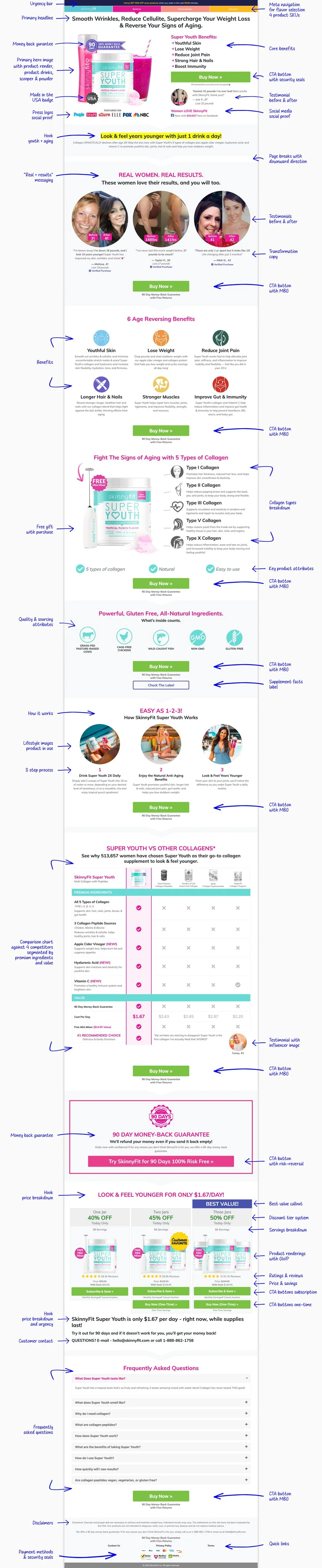
Determining What Earned Its Place
Once I understood the purpose behind each section, the next step was deciding what belonged in the new experience.
Not everything needed to be removed. Not everything needed to stay exactly as it was.
Some things were working and earned their place. Other sections needed to be refined, consolidated, or reimagined through a more modern UX lens. A few no longer added enough value and were left behind entirely.
This exercise helped transform years of ideas, testing, and iteration into a more intentional system. One that could scale across multiple products while preserving the direct response principles that made the original landers successful.
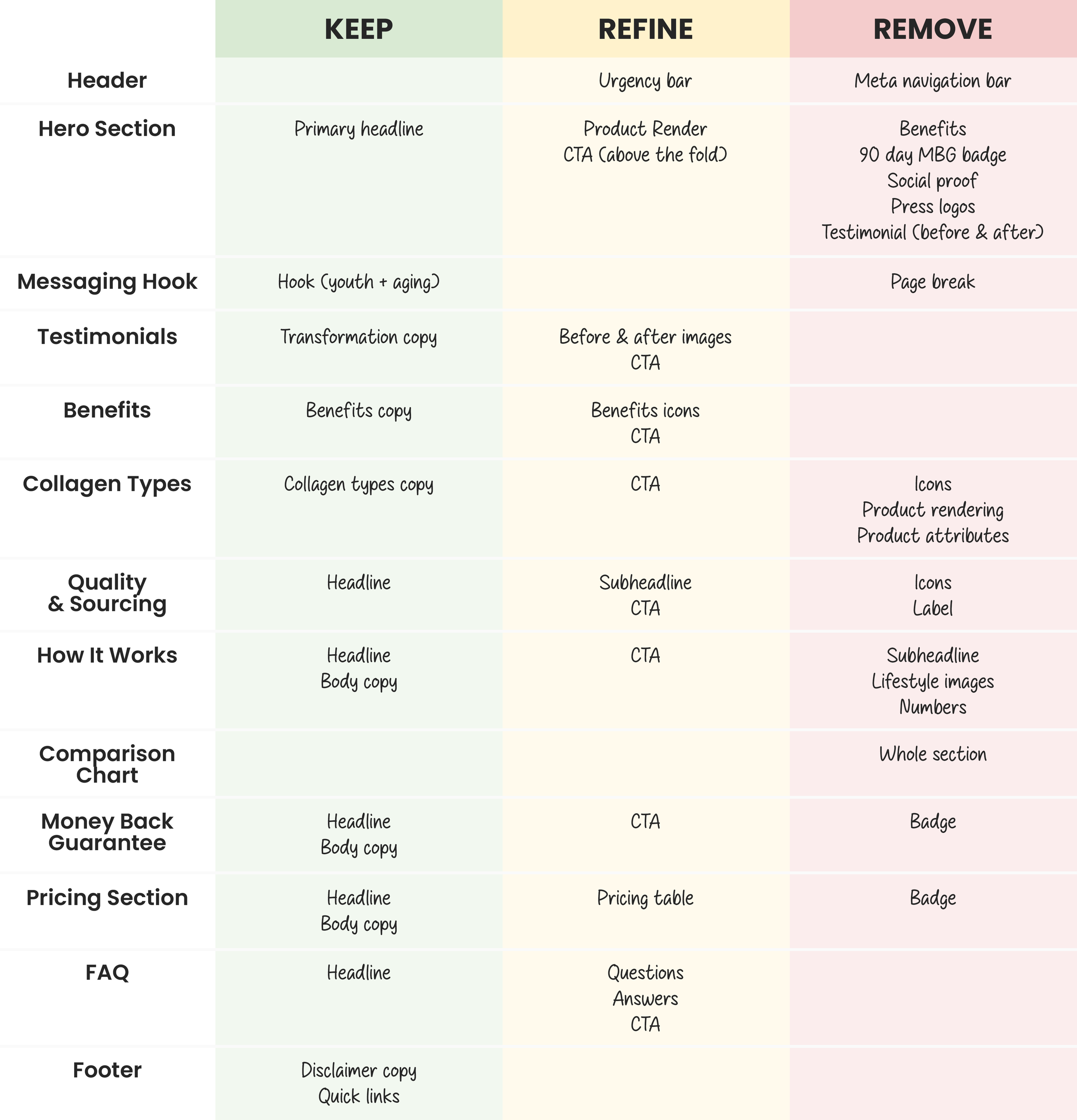
Rebuilding the Experience Through Wireframes
Once I understood what earned its place, I could start rebuilding the experience through wireframes.
This wasn’t about making things look better yet. It was about creating structure. I reorganized content, simplified the flow, and focused on how each section connected to the next.
The biggest challenge was finding the right balance. I wanted to preserve the direct response principles that had made the original landers successful while creating a cleaner and more intentional experience.
I also knew this couldn’t solve for just one product. If the redesign worked, it would eventually need to support the rest of the SkinnyFit portfolio. The wireframes became the foundation for a framework that could scale across multiple products without starting from scratch each time.

The Work
Bringing the Framework to Life
After months of analysis, wireframing, and iteration, it was finally time to bring the new framework to life.
The first rollout focused on Super Youth Tropical Punch. At the time, it was SkinnyFit’s top-selling acquisition product. But I wasn’t designing for one SKU. I was designing for a system that could scale.
One thing I felt was missing from the original experience was emotion. It lacked personality. It lacked human connection. Outside of testimonials, there were very few moments that felt aspirational or alive.
Having worked on more than a dozen photoshoots, I knew we had a library full of incredible lifestyle imagery. I wanted the new experience to feel colorful. Refreshing. Human. Something that made you feel good while still guiding you toward a purchase decision.
The result was a more modern acquisition framework that balanced storytelling, education, trust, and conversion. One that could adapt across multiple products while maintaining a consistent experience.

Built to Scale Across Products
What started as a single direct-response landing page became a flexible framework built to scale. The same strategic structure was adapted across three additional wellness products, each with its own audience, benefits, ingredients, and messaging while maintaining a consistent conversion journey.



From a Single Lander to a Scalable Framework
The redesigned Super Youth Tropical Punch lander eventually surpassed the previous control and became the foundation for future acquisition landers.
What started as a redesign for a single product quickly grew into something much bigger. The framework was rolled out across multiple product categories and eventually supported 15 products throughout the SkinnyFit portfolio.
It also changed the way I approached direct response design. Instead of thinking about individual pages, I started thinking about systems. How content should flow. How sections should connect. How a framework could adapt as products, offers, and customer needs evolved over time.
Even years later, many of the core principles and structural decisions from this project remained in place as the landers continued to evolve.
Holy crap… that period of my life was kind of insane.
Black Friday and Cyber Monday campaigns were in full swing. The entire Super Youth product line was going through a major reformulation. We were launching new packaging. We were planning and executing photoshoots. There were development handoffs. Many, many rounds of QA. And somehow all of it was happening at the same time.
I’m still not entirely sure how I pulled it all off. Somehow it all came together. Looking back now, I think this project taught me that I’m capable of handling much more than I ever gave myself credit for.
Lessons Learned
Understand Before You Change
When I joined the company in 2018, I didn't really understand what the business was built on: direct response. I came from a much more branded background. Clean layouts. Polished experiences. Consistent design systems.
Then I saw the SkinnyFit acquisition landers.
At first glance, I honestly could not wrap my mind around what was going on visually. My inner instincts of cringe were on high alert.
Over the years, I pitched new concepts and designs more than once. Every time they were rejected. Looking back, I understand why. Most of my ideas focused on replacing what existed instead of building on it. The truth was, I didn't fully understand what made those pages successful. I was too focused on why they were "ugly."
As the years passed, I became more involved in the business. I learned Klaviyo. I supported landing page requests. I started to understand how acquisition and retention worked together. By 2023, things felt different. Layoffs had happened. Sales weren't where they needed to be. You could feel the pressure across the business. Everyone was searching for answers.
That's when I was finally given the opportunity I'd been asking for. At first, I was excited. Then I realized the responsibility that came with it.
Oh... this isn't a redesign exercise anymore. This might actually need to work.
So instead of starting with what I wanted to change, I started with understanding what already existed. I studied every section. Every message. Every trust signal. Every conversion tactic. Some things felt outdated. Some things needed improvement. But almost everything was there for a reason.
That shift changed everything. The redesign wasn't successful because I introduced something new. It was successful because I finally understood what I was building on. Looking back, one of the biggest lessons from this project is that understanding should come before change. The best solutions don't ignore what came before them. They learn from it first.
They Don’t Have to Compete
For a long time, I had viewed branding and direct response as opposites.
Branding was clean. Intentional. Emotional. It felt like every piece fit together like a completed puzzle. It just worked.
Direct response felt like the complete opposite. More crowded. More aggressive. Less focused on looking good and more focused on getting someone to take action. Click the button. Buy the product. Convert.
Well... at least that's what I thought.
The more I studied the existing SkinnyFit landers, the more I realized the direct response principles weren't the problem. The problem was that over time the experience had lost much of its personality. It lacked emotion. It lacked aspiration. And it lacked the human connection that had become such an important part of the SkinnyFit brand.
That's where I saw an opportunity.
Not to replace direct response. Not to throw away what was already working. But to see if I could help bring some of that personality back into the experience.
The goal was never to turn a direct response lander into a brand page. It was to find the right balance between the two. Preserve the conversion principles that were already working. Introduce stronger storytelling. More lifestyle imagery. And a more modern customer experience.
Was it really direct response versus branding? Or could the best experiences borrow from both?
Looking back, that's one of the biggest lessons I took away from this project. Performance and brand don't have to compete with each other. When they're working together, they become much more powerful.